
Start with the pain
Interesting technology is everywhere. Important problems are harder to find. I would rather solve a painful problem with simple technology than build sophisticated technology looking for a reason to exist.
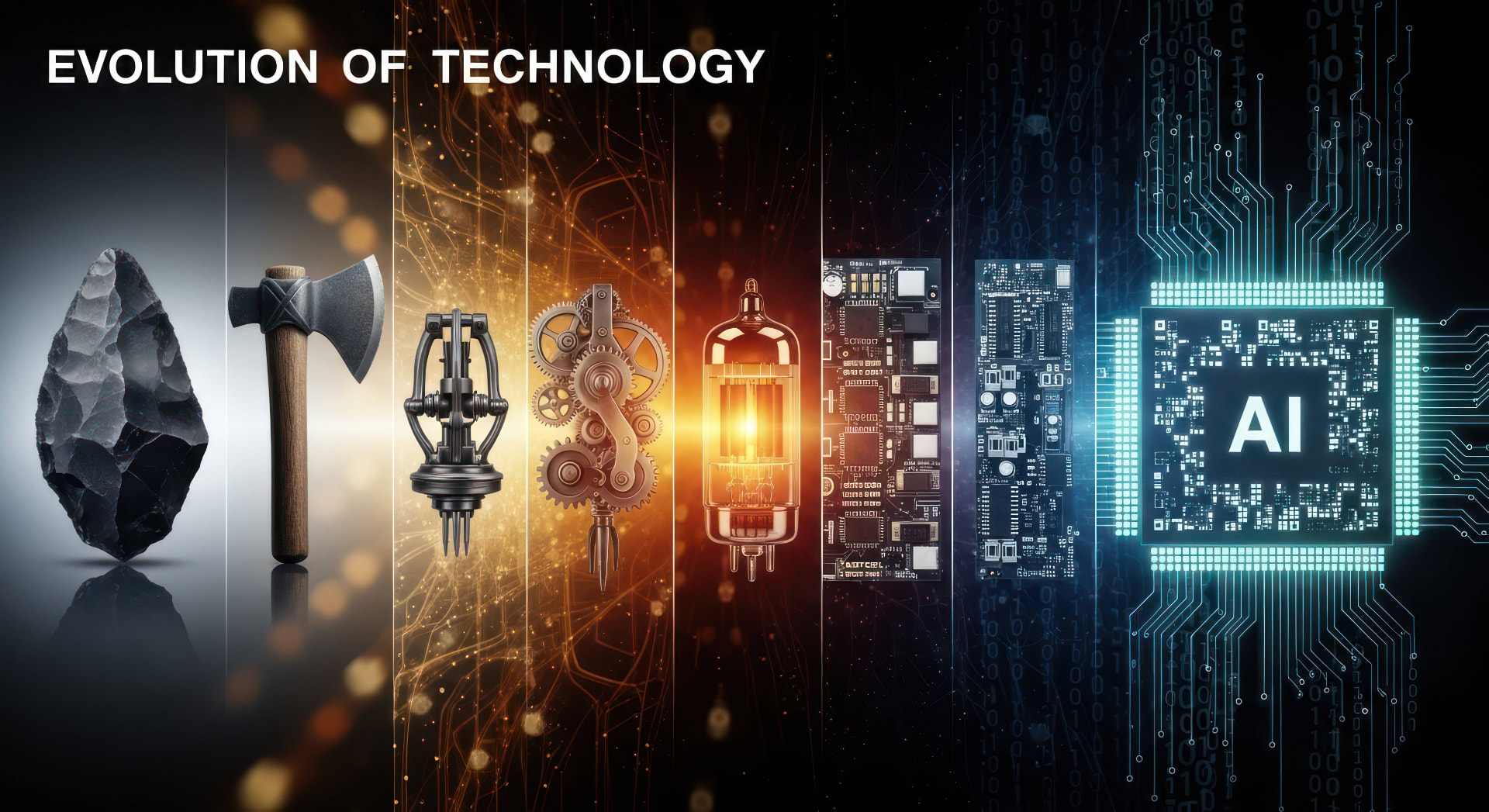
A builder's perspective / 2026
We are not just adding AI to the old world. We are rebuilding the world around it.
Every major technological shift changes more than the tools we use. It changes what becomes possible, what becomes valuable, and ultimately what gets built.
Enter the thesis01 / The shift
For decades, software was built around people entering information, navigating interfaces, following workflows, and making decisions manually. The next generation of companies will look different.
I believe this creates an extraordinary opportunity to build.
02 / From software to intelligence
The first era of digitization put information on screens. The next connected those screens to the cloud. The AI era goes further: technology begins to understand, reason, predict and act.
Instead of simply recording what happened, systems can help determine what should happen next.
Instead of searching through information, we can interact with intelligence built around that information.
Instead of operating every process manually, people can increasingly define objectives while intelligent systems coordinate the work underneath.
The interface becomes less important.
03 / Physical AI
Some of the most interesting opportunities in AI will not exist purely on a screen.
They will emerge where AI meets the physical world.
When physical environments can sense what is happening, understand that information and respond intelligently, entirely new products become possible.
This is one of the areas I am particularly interested in building around: moving intelligence beyond the computer and embedding it into the environments in which we actually live and work.
04 / Problem first
AI alone is not a business. Neither is IoT, robotics, blockchain, computer vision or any other technology. Technology becomes meaningful when it removes friction from something that matters.
That means starting with questions such as:
The technology comes after the problem.
05 / One common idea
My ventures operate across very different industries and problem spaces.
Peytec. RavenTrack. StrengthPro.ai. Molly Group. Hooloo. FutureState. Eris Canada.
They are not intended to be variations of the same company.
But underneath them is a common philosophy:
Find industries where technology can create a structural advantage, not simply another feature.
Sometimes that means connecting the physical and digital worlds. Sometimes it means using AI to transform information into decisions. Sometimes it means rethinking an established business model entirely.
The industries change. The question stays remarkably similar:
What should this look like if we were building it today?
06 / Operating system
Interesting technology is everywhere. Important problems are harder to find. I would rather solve a painful problem with simple technology than build sophisticated technology looking for a reason to exist.
AI should not be a button added to an existing workflow. The most compelling products will increasingly be designed around intelligence from the beginning.
Some of the largest opportunities exist where software interacts with physical operations, assets, people and infrastructure.
Products become more powerful when use creates data, data improves intelligence and intelligence makes the product increasingly valuable.
The technology underneath a product may be extraordinarily sophisticated. The experience should not feel that way.
Great companies cannot only solve today's problem. They need an architecture capable of participating in tomorrow's world.
07 / The AI-native company
AI does not only change products. It changes how companies are built.
Small teams can now operate with capabilities that once required entire departments.
This changes the economics of entrepreneurship.
The company of the future may not simply be a traditional organization using AI tools.
It may be an AI-native organization designed from first principles around human judgment, machine intelligence and automation.
That is a much more interesting idea.
08 / The partnership
I don't believe the future is simply about replacing people.
It is about changing what people spend their time doing.
Machines are extraordinarily good at processing information, recognizing patterns, generating possibilities and executing repeatable work.
Humans remain extraordinarily important for curiosity, judgment, relationships, imagination, leadership and deciding what should exist in the first place.
The most powerful organizations will combine both.
Not human versus machine.
Human × machine.
09 / The compounding loop
I don't view entrepreneurship as a collection of isolated companies. Every venture creates knowledge.
A lesson in industrial IoT can influence how you think about physical AI.
A problem discovered in construction can reveal a broader opportunity in financial intelligence.
A breakthrough in sensing can create possibilities in entirely different industries.
Technology compounds. So does experience.
Building multiple companies creates an opportunity to carry ideas, technologies, relationships and lessons from one world into another.
That cross-pollination is often where the most interesting ideas begin.
10 / Now
AI is moving extraordinarily quickly. No one knows exactly what the next decade will look like.
That uncertainty is precisely what makes this period interesting.
This is the time to build.